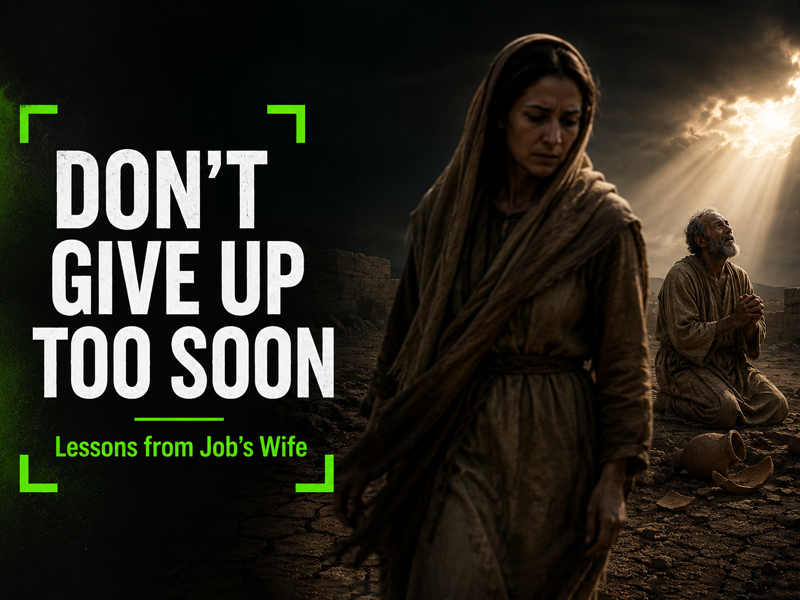
She’s only in the story for a moment, but her line is the one people remember: curse God and die. It’s easy to judge her from a safe distance. It’s harder to admit how many of us have said some version of that sentence, just quieter, just to ourselves, on our worst night. LATECOMER BY Kingsley A. Ononuju doesn’t let her off the hook, but it doesn’t let the rest of us off either.
Here’s what she got wrong: she measured the situation only by what she could see- a husband covered in sores, children gone, a fortune erased- and concluded that the story was over. LATECOMER BY Kingsley A. Ononuju points out something she couldn’t have known standing inside that grief: Job’s suffering wasn’t the end of the story. It was the middle of one that would double everything he’d lost.
That’s the uncomfortable, useful thing about her character. She wasn’t wrong about the pain. She was wrong about what the pain meant. And that’s a mistake that doesn’t belong only to her; it belongs to anyone who’s ever decided, mid-suffering, that the silence from God is final.
What LATECOMER BY Kingsley A. Ononuju offers instead is a harder discipline: staying in the story past the point where quitting would be reasonable. Job didn’t pretend the pain wasn’t real. He argued with God, grieved openly, asked hard questions, but he didn’t close the book on it. That distinction matters more than it sounds like it should.
Job’s wife isn’t a villain. She’s a mirror. She shows us exactly how tempting it is to let the worst chapter convince us it’s the last one.
Who in your life is standing where she stood, ready to close a story that isn’t finished? Tag them below. Sometimes the encouragement to keep going has to come from someone standing outside the grief.
To read the fuller account of how the wait resolves, LATECOMER BY Kingsley A. Ononuju is available now on Amazon and through the author’s official website.